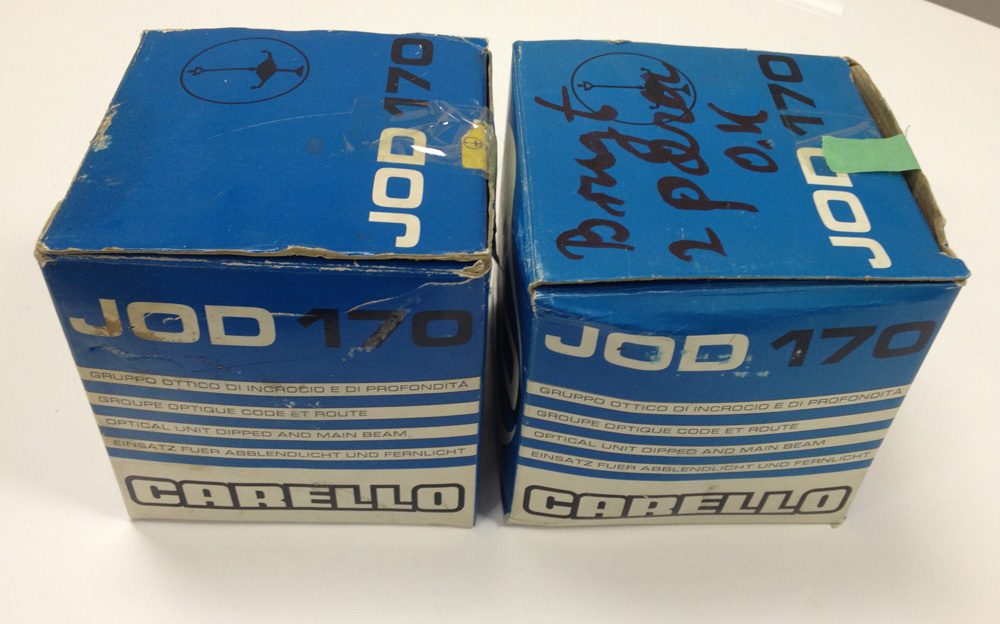
NOS headlights were sourced from a gentleman in France and they will replace the tired units to come off of 01464. Upon opening the package we discovered original installation instructions and quality control tags dated February 1970. Now this may be a stretch but it is not outside the realm of possibility that these lights were manufactured in the same batch that was supplied to Ferrari when our Dino was made. Carello did not produce a lot of lights and this particular model has a fairly narrow application range so we may have just sourced the sibling light to those originally fitted to our car. Regardless it was a cool find and a very authentic addition to our restoration.
Thursday, December 8, 2011
Saturday, December 3, 2011
A little help from Sweden. The fuse panel is made
As so many stories begin with 01464 'At some time in the life of our car....the fuse panel was changed' In this case it was changed to a later North American spec fuse panel leaving us to make a new one from scratch .
The first step was to get phenolic board. This was achieved by the generosity of fellow car collector Randy P. and his company Paisley Products of Canada who supplied us with material. This was an easy request for Randy but he made sure to pull out some real old stock from the early 70's to make our panel totally authentic.
The next step was to measure an original panel and make a drawing. This is when some old IKEA furniture (thus the Swede influence) was sacrificed to make a jig that would hold the material while being placed in our milling machine. Material was cut to size and then covered in a self adhesive paper (used by sign makers to pre-mask decals) so that we could draw visible guide lines on. Of course measurements were checked many times and finally we got cutting.
The final result is nothing short of perfect. We are really pleased and look forward to building up the whole fuse panel just as soon as we re-plate all the mounting screws and relays.
Now for some pics.
The first step was to get phenolic board. This was achieved by the generosity of fellow car collector Randy P. and his company Paisley Products of Canada who supplied us with material. This was an easy request for Randy but he made sure to pull out some real old stock from the early 70's to make our panel totally authentic.
The next step was to measure an original panel and make a drawing. This is when some old IKEA furniture (thus the Swede influence) was sacrificed to make a jig that would hold the material while being placed in our milling machine. Material was cut to size and then covered in a self adhesive paper (used by sign makers to pre-mask decals) so that we could draw visible guide lines on. Of course measurements were checked many times and finally we got cutting.
The final result is nothing short of perfect. We are really pleased and look forward to building up the whole fuse panel just as soon as we re-plate all the mounting screws and relays.
Now for some pics.
Wednesday, November 30, 2011
How will we get this all back together? We now have a manual
Today we received an original parts book for the Dino courtesy of Ferrariliterature.com . For anyone missing original documents they have excellent quality stuff and an amazing collection to choose from.
Now we at least know how everything should go back together.
Tuesday, November 22, 2011
More investigation: The three 'P's' of restoration.
When working on the engine and gearbox assembly we have come across the following materials
Smooth magnesium (Dow Dichromate finish) - As used in early Dino cam covers, oil filler, and some other covers
Cast Iron (painted black)- As used in the engine block
Smooth cast aluminum (left unfinished)- As used on the main cover plate on the water pump side
Shiny pressure cast aluminum (left unfinished) - As used on the heads and intake manifold
Rough cast aluminum (painted silver)- As used in the gearbox and engine sump
While all of the finishes made sense to us, it was the painted rough cast aluminum that had us wondering. Was the silver paint original? and Why would Ferrari bother painting the aluminum? Some investigation work was needed.
To answer the first question we checked a number of cars and luckily had access to some NOS parts to look at. Upon inspecting we determined that without a doubt the parts were first painted and then received their finish machining to clean off all mating surfaces.
The second question then asked: 'why paint the aluminum?' Further investigation revealed that the surfaces that were exposed to engine oil were painted in a greenish zinc chromate primer. By VERY carefully removing original paint from our NOS casting we could see that there were traces of the zinc primer on the outside where it had been painted silver. This led us to conclude that the parts were painted all in zinc chromate primer, and then the outside surfaces were painted silver, followed by finish machining.
The question still existed as to 'Why paint in the first place?' The answer came with some research into the methods used to make the rough aluminum castings. These castings were made when molten aluminum was poured into sand molds which were later broken away to reveal the finished part. Because these were gravity castings with no pressure applied during the pouring or cooling stages, the molds were weaker than those found in pressure casting. These weaker molds can cause sand and other particulates to deposit themselves loosely on the final cast part. As such, manufacturers use the zinc chromate paint (which acts as a sealing primer) to seal the outer surface of aluminum and encapsulate any sand particles that could otherwise find themselves into the oiling system and damage the engine. The outside surfaces are merely painted silver to match the cast look of the aluminum.
It appears as though with these cars the detective work never ceases. You are either looking for People, Parts, or Processes.
Smooth magnesium (Dow Dichromate finish) - As used in early Dino cam covers, oil filler, and some other covers
Cast Iron (painted black)- As used in the engine block
Smooth cast aluminum (left unfinished)- As used on the main cover plate on the water pump side
Shiny pressure cast aluminum (left unfinished) - As used on the heads and intake manifold
Rough cast aluminum (painted silver)- As used in the gearbox and engine sump
While all of the finishes made sense to us, it was the painted rough cast aluminum that had us wondering. Was the silver paint original? and Why would Ferrari bother painting the aluminum? Some investigation work was needed.
To answer the first question we checked a number of cars and luckily had access to some NOS parts to look at. Upon inspecting we determined that without a doubt the parts were first painted and then received their finish machining to clean off all mating surfaces.
The second question then asked: 'why paint the aluminum?' Further investigation revealed that the surfaces that were exposed to engine oil were painted in a greenish zinc chromate primer. By VERY carefully removing original paint from our NOS casting we could see that there were traces of the zinc primer on the outside where it had been painted silver. This led us to conclude that the parts were painted all in zinc chromate primer, and then the outside surfaces were painted silver, followed by finish machining.
The question still existed as to 'Why paint in the first place?' The answer came with some research into the methods used to make the rough aluminum castings. These castings were made when molten aluminum was poured into sand molds which were later broken away to reveal the finished part. Because these were gravity castings with no pressure applied during the pouring or cooling stages, the molds were weaker than those found in pressure casting. These weaker molds can cause sand and other particulates to deposit themselves loosely on the final cast part. As such, manufacturers use the zinc chromate paint (which acts as a sealing primer) to seal the outer surface of aluminum and encapsulate any sand particles that could otherwise find themselves into the oiling system and damage the engine. The outside surfaces are merely painted silver to match the cast look of the aluminum.
It appears as though with these cars the detective work never ceases. You are either looking for People, Parts, or Processes.
Saturday, November 19, 2011
The Distinguished Gentleman. Our Dino is re-united with its original salesman
Today was a very special day. For the first time in some forty years, our Dino was re-united with the salesman who sold the car new. It is with great pleasure that we introduce to you Mr. Scot Macdonald who is only a few days shy of his 90th birthday.
This all came about when Paul caught wind that Scot was around and well living in a veteran’s home in Toronto . Some quick digging revealed his telephone number and it was not long before we had him on the phone and made arrangements to pick him up and have him visit 01464. Word spread of our plans and today we spent a marvelous day while many different owners and enthusiasts stopped by. In all there were 3 cars present that Scot sold including a 1977 Ferrari 308 GTB that the owner had the original sales card with Scot’s signature in it.
Despite his age, Scot makes many 70 year olds look dated. He is sharp and lucid with a quick wit and excellent story telling ability. We were all enthralled with dozens of stories which included a cross country delivery drive of a BB512 that was traded in for a Daytona (that he then had to drive back), picking up a Countach in Texas and driving it back to Toronto, the day 3 Daytona spiders arrived and what he did to sell them, and the list when on and on.
The weather was great and things could not have gone better. We offered Scot a drive when the car is done and look forward to fulfilling that promise. He also provided us with a piece of wisdom stating that because our heart is going into every nut and bolt of this car, that we will always have a connection to it that is not possible by just buying a finished product. That truly is what makes the restoration worthwhile.
Now on to the photos. The first one was taken at the very instance Paul was getting the aforementioned advice.
Subscribe to:
Posts (Atom)


